# Database Structure
Within **Data & Content Management**, database structure plays a key role in ensuring **clean data separation**, **governed access**, and **environment‑appropriate usage** of information across the application lifecycle.
ONEWEB uses **different database structures for Development and for User Acceptance / Production environments** to balance flexibility during design time with stability and safety during runtime.
***
#### **Environment‑Specific Database Design**
ONEWEB distinguishes database usage based on environment:
* **Development Environment**
* **User Acceptance (UAT) / Production Environment**
Each environment serves a different purpose and therefore requires a different database setup.
***
#### **Development Environment**
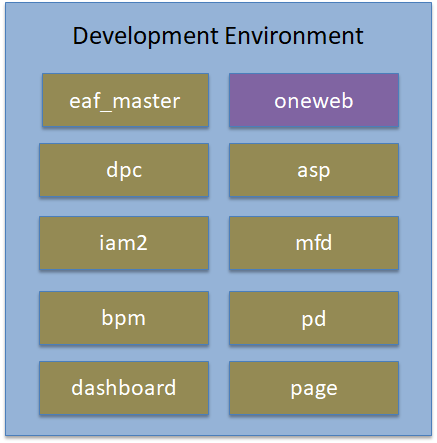
In the **Development environment**, **all schemas must be installed**.
This is required because:
* Designers use preview and simulation features
* Page Designer, App Designer, Microflow, and Process tools insert and modify configuration data
* Full access to design‑time metadata is required for accurate runtime simulation
This environment prioritizes **flexibility and completeness** over restriction.
***
#### **User Acceptance & Production Environment**
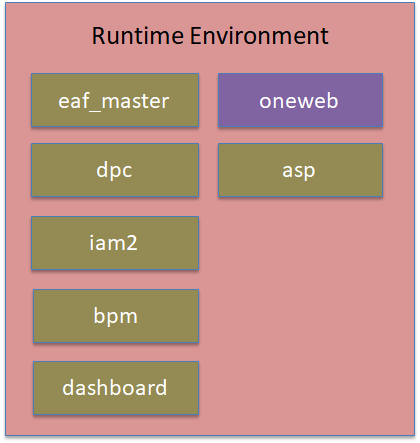
For **User Acceptance Testing (UAT)** and **Production**, ONEWEB **recommends installing only the runtime schema**.
This approach:
* Reduces unnecessary exposure to design‑time data
* Limits database surface area
* Improves performance and stability
* Supports cleaner data governance
Production environments should focus on **execution and consumption of data**, not design or configuration changes.
***
#### **Database Structure Overview**
The diagrams below illustrate the difference between full‑schema installation (Development) and runtime‑only installation (UAT / Production):
***
#### **Schema Description**
ONEWEB organizes data and configuration using dedicated schemas, each serving a distinct role within **Data & Content Management**.
| Schema | Description |
| --------------- | ---------------------------------------------------------------- |
| **eaf\_master** | Stores application and Smart Form configuration metadata |
| **oneweb** | Stores application business data designed through App Designer |
| **dpc** | Stores server, environment, and deployment service information |
| **asp** | Stores project information, components, members, and permissions |
| **iam2** | Stores user accounts, roles, objects, and permission mappings |
| **mfd** | Stores Microflow definitions and configurations |
| **bpm** | Stores runtime process instances during process execution |
| **pd** | Stores process configurations, roles, users, and work parties |
| **dashboard** | Stores dashboard and chart configuration data |
| **page** | Stores page configurations for web and mobile applications |
***
#### **Database Structure as Part of Data & Content Management**
From a data and content management standpoint, this multi‑schema structure enables:
* Clear separation between **design‑time metadata** and **runtime data**
* Cleaner ownership and responsibility per data domain
* Reduced risk of configuration changes affecting production data
* Scalable application architecture across multiple environments
This structure supports **long‑term maintainability and governance** of both data and content.
***
#### **Summary**
The ONEWEB database structure is intentionally designed to support **controlled data usage**, **environment‑specific responsibilities**, and **strong data governance**.
By using different schema strategies for Development versus UAT/Production environments, ONEWEB ensures that:
* Designers have full flexibility during development
* Runtime environments remain stable and secure
* Data and content are properly isolated by purpose
* Applications scale cleanly across environments
This approach forms a solid foundation for sustainable **Data & Content Management** in enterprise‑grade applications.
---
# Agent Instructions: Querying This Documentation
If you need additional information that is not directly available in this page, you can query the documentation dynamically by asking a question.
Perform an HTTP GET request on the current page URL with the `ask` query parameter:
```
GET https://docs.onewebstack.com/oneweb-platform-th/building-apps/data-and-content-management/database-access-management/database-structure.md?ask=
```
The question should be specific, self-contained, and written in natural language.
The response will contain a direct answer to the question and relevant excerpts and sources from the documentation.
Use this mechanism when the answer is not explicitly present in the current page, you need clarification or additional context, or you want to retrieve related documentation sections.